Forex Broker E-E-A-T, what we need to know?
This article is about E-E-A-T as a trust signal framework for AI search engines — ChatGPT, Perplexity, Google AI Overview, Gemini, and Claude — not about AI as a forex trading tool. If you arrived looking for AI trading signals or algorithmic forex strategies, this is not that article.
Google’s E-E-A-T framework — Experience, Expertise, Authoritativeness, Trustworthiness — was developed to help Google Search evaluate content quality. Google’s own Search Central documentation remains the primary reference for the framework. This article answers a different question: how do AI language models actually weight each E-E-A-T dimension when evaluating regulated forex broker content for citation, and how does that differ from how Google Search weights them? For the broader strategy context, see the AEO/GEO strategy overview for forex brokers.
The critical difference is operational, not conceptual. Google Search evaluates E-E-A-T partly through external signals accumulated over time — the link graph, domain authority, citation patterns across the web. AI retrieval systems work differently: when a language model retrieves a page to answer a query, it scores the retrieved content block using only what is explicitly written there. It cannot query a backlink profile in real time. A regulated forex broker with strong SEO authority may still lack the explicit in-content E-E-A-T signals AI engines require — the authority exists, but it is not in the content block being scored.
Table of Contents
E-E-A-T for AI Citation: What Changes Versus Traditional Search
For Google Search, E-E-A-T builds over time. A site with ten years of financial content, strong backlinks from financial media, and consistent author profiles accumulates an implicit credibility signal that Google’s algorithm can assess without every page explicitly stating its credentials. That implicit authority is real and it works for rankings.
For AI citation, the same implicit authority is largely invisible. When an AI engine’s retrieval system processes a page to answer a query, it scores the retrieved content block for relevance and trustworthiness using what is written in that block. The trust signals must be in the text. The author’s credentials must appear near the content. The regulatory credential must be stated. The primary source must be linked. A high-authority financial site with pages that carry no explicit E-E-A-T signals may rank in position one on Google and be invisible in ChatGPT answers for the same branded queries — as confirmed consistently in common AI visibility audit findings.
The Formula — Explicit Beats Implied for AI Citation
Implied: “We are regulated to the highest standards.” → Uncitable claim. No verifiable fact for the engine to extract.
Explicit: “[Broker] Limited is authorised by CySEC under CIF Licence [X], verified at the CySEC public register [URL].” → Citable, verifiable, entity-specific. Same intent. Completely different AI citation outcome.
The practical consequence for content strategy: the forex broker SEO audit and the structuring content for AI citation guide address complementary gaps. The SEO audit measures what Google sees; the AI visibility audit measures what AI engines can extract. A broker needs both to be optimised for both channels.
Experience — Who Wrote This, and Can You Prove It?
Google’s E-E-A-T framework defines Experience as first-hand experience with the topic — a product reviewer who has used the product, a patient writing about their condition. For YMYL content, it expects content to be created by or reviewed by appropriately experienced people.
For a regulated forex broker’s regulation page, conditions page, and FAQ page, the Experience signal for AI citation purposes is the named compliance professional associated with the content. A generic “Marketing Team” byline on a regulatory disclosure page tells the AI engine nothing about whether the person responsible for that content has the appropriate professional background to make regulated financial statements. A named compliance officer with a verifiable professional background — searchable LinkedIn profile, compliance role tenure, registered professional credentials — tells the engine that a qualified person is responsible for the content it is about to cite.
The practical action: add a byline or formal review attribution to the regulation page, conditions page, and FAQ page — not the blog author, but the person with the appropriate compliance background. “This page has been reviewed by [Name], Head of Compliance at [Entity], regulated by CySEC” provides the Experience signal even without formal authorship attribution.
A practical caveat: some regulated entities prohibit named individual attribution on public-facing content for compliance or legal reasons — the individual’s name appearing on a client-facing page can create personal liability implications in certain jurisdictions. Where named individual attribution is not permitted, the compliant alternative is entity-level review attribution: “This page has been reviewed by the Compliance Department of [Entity Name], authorised and
Expertise — The Licence Number as Verifiable Credential
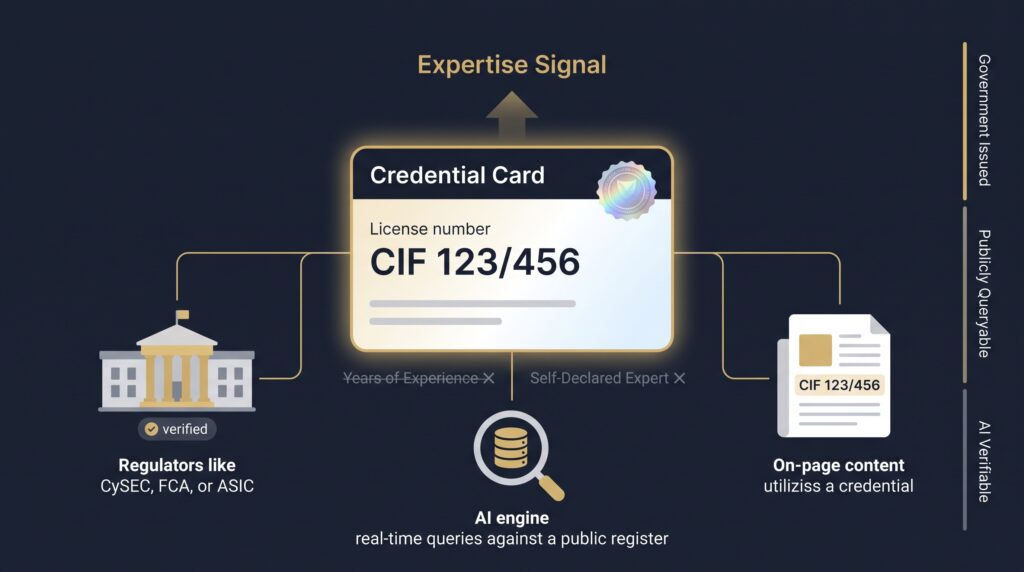
Google’s framework defines Expertise as appropriate knowledge or skills for the topic — a medical article needs a medical professional, a financial article needs a financial expert. For most businesses, demonstrating Expertise means naming a qualified author. Regulated forex brokers have something more powerful.
A CySEC, FCA, or ASIC licence is a government-issued, publicly queryable proof of qualified competence to provide financial services. It is granted only after a formal regulatory assessment by a statutory authority. It carries a specific number that can be cross-referenced in a public database by anyone — including an AI engine during a retrieval cycle. For Expertise purposes, a regulatory licence is the most verifiable professional credential available to any financial services business, and it is stronger than any self-declared expertise claim a non-regulated content publisher can make.
The translation to content is direct. The Expertise signal for AI citation is not the broker’s years of market experience or the quality of its trading analysis — it is the licence number, stated explicitly in the content, paired with the entity name, and linked to the regulator’s public register. This tells the AI engine: this entity has been formally assessed as qualified to provide financial services in this jurisdiction by this regulatory authority.
The broker pages I audit most often treat the licence number as a legal disclosure requirement — something that appears once in the footer in 9-point text to satisfy a regulatory obligation. The same licence number is the strongest Expertise signal available to an AI engine evaluating whether a financial source can be trusted to make regulatory claims. A number buried in a footer is not in the content block the AI engine retrieves. A number stated explicitly in the first paragraph of the regulation page, paired with the entity name and linked to the CySEC public register, is.
Authoritativeness — Being Known by the Sources AI Engines Trust
Google Search builds Authoritativeness through the link graph — how many authoritative sources reference your site as a trusted source on the topic. For AI citation, the relevant question is different: which trusted third-party sources describe this broker, and is that description accurate and specific enough for the engine to use as a citation?
For a regulated forex broker, the Authoritativeness hierarchy for AI citation runs in a specific order. The regulator’s own public database is at the top — a CySEC register entry confirming an entity’s licence and authorised services is the most authoritative third-party description available, and it carries the weight of a statutory authority behind it. Financial media follows — Finance Magnates, Investing.com, FX Empire — where accurate named mentions of the broker’s regulatory status and licence carry YMYL credibility because these publications have editorial accountability. Comparison platforms (ForexBrokers.com, Investopedia broker reviews) follow — accurate listings of the broker’s conditions and entity structure. Community forums (Forex Factory, Forex Peace Army) are the lowest in the hierarchy but still signal presence.
The critical maintenance requirement: Authoritativeness for AI citation requires that these descriptions be accurate, not merely present. An authoritative source that describes the broker inaccurately — wrong licence number, outdated entity, incorrect jurisdiction — actively undermines AI citation quality by giving the engine confident wrong information from a trusted source. Full hierarchy and remediation approach in the third-party source hierarchy for regulated forex brokers.
Trustworthiness — Verifiable Claims, Linked to Primary Sources
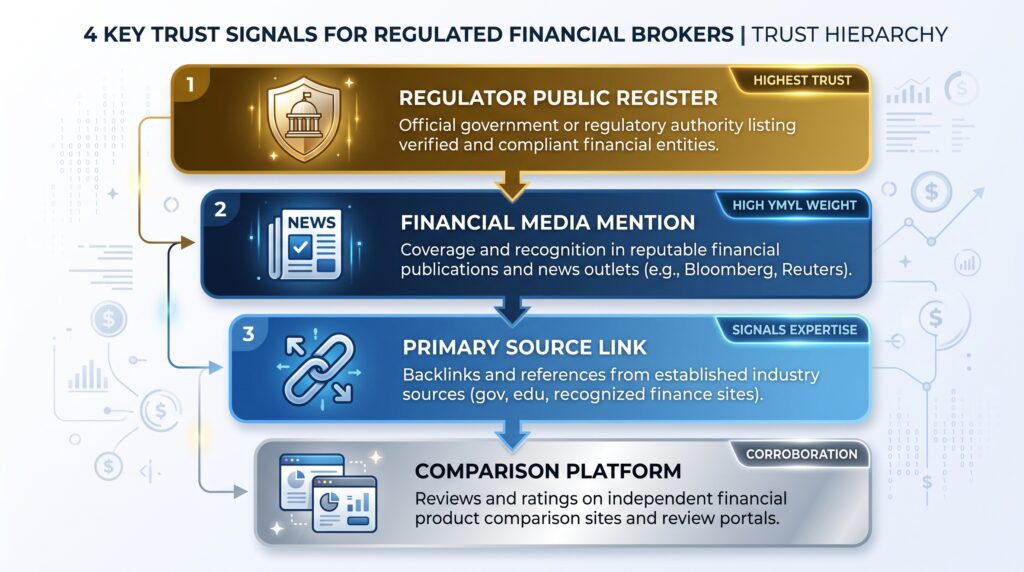
Trustworthiness in Google’s framework covers accurate, honest, transparent content — citing sources, being clear about who runs the site, not misrepresenting information. For YMYL financial services content, AI engines apply this dimension with particular scrutiny: can this regulatory claim be verified from a non-commercial source, or is the broker asserting its own compliance without external confirmation?
The single most powerful Trustworthiness signal for a regulated forex broker is the regulator’s own public database. A regulation page that states the licence number and links directly to that specific entry in the CySEC, FCA, or ASIC register has provided Trustworthiness in its most verifiable form. The claim is not only stated by the broker — it is linked to the statutory authority that issued the licence. An AI engine can retrieve that link, confirm the claim, and cite the broker’s regulatory content with confidence.
| Signal Type | Example for a Regulated Forex Broker | How AI Engines Use It | Action Required |
|---|---|---|---|
| Regulator Public Register | CySEC register entry for [Broker] Limited, CIF Licence [X], linked from regulation page | Cross-references the claim against the statutory authority. Highest-trust verification available for financial services licences. | Ensure register listing is accurate; link from regulation page directly to the specific entry (not the register homepage). |
| Financial Media Mention | Finance Magnates article naming the broker’s CySEC licence and entity accurately | Editorially-accountable third-party description. High YMYL trust weight because publication has accountability for accuracy. | Audit existing media mentions for factual accuracy. Submit corrections for inaccurate descriptions via editorial outreach. |
| On-Page Primary Source Link | Outbound link to ESMA regulation page confirming 1:30 retail leverage limit for major FX pairs | Confirms specific regulatory claims against the originating regulatory source. Signals content was written by someone who knows where to find primary sources. | Add outbound links to ESMA, FCA, CySEC, or ASIC primary pages for every regulatory claim stated on the regulation and conditions pages. |
| Comparison Platform Listing | ForexBrokers.com entry accurately stating the broker’s licence, entity, and key conditions | Third-party, non-self-interested description. Lower trust weight than regulator register or financial media but contributes to corroboration. | Ensure listing is accurate — correct licence, current entity, current conditions. Submit corrections where inaccurate. |
YMYL Tier for Regulated Finance — The Highest Scrutiny Category
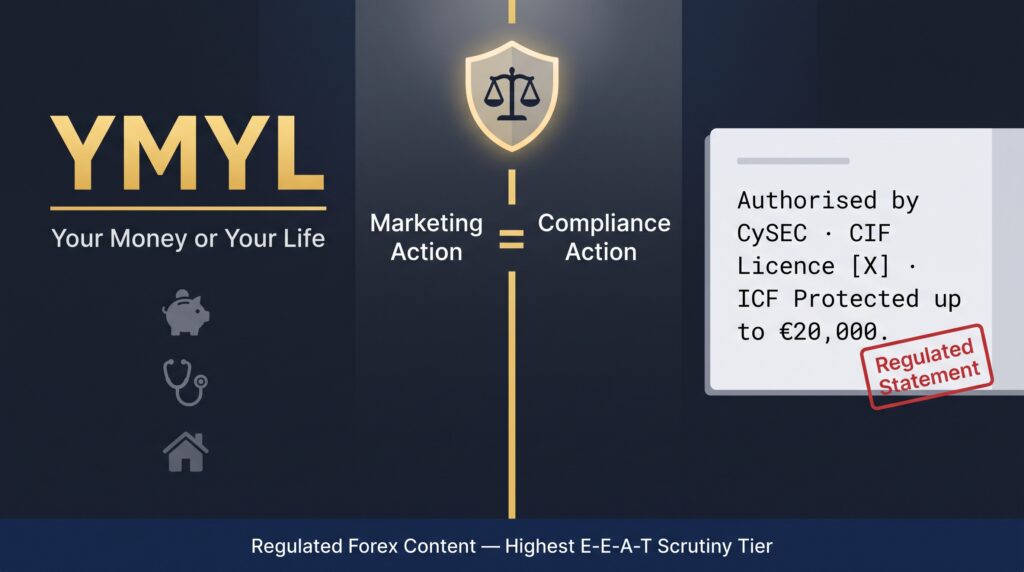
Google’s YMYL classification applies to content that can significantly affect a person’s finances, health, or safety. All financial content is YMYL — personal budgeting blogs, investment comparison sites, pension advice. All YMYL content faces elevated E-E-A-T requirements from AI engines. Regulated forex broker content sits in a particularly strict tier within this broader YMYL category.
A broker’s regulatory disclosure — “we are authorised by CySEC under CIF Licence [X], your funds are protected under the Investor Compensation Fund up to €20,000” — is not an opinion about finance. It is a regulated statement about a licensed entity’s legal obligations. Getting it wrong is a compliance error, not a content quality error. AI engines processing this content apply the highest available scrutiny because the consequences of a wrong citation — a prospect or regulator receiving incorrect information about a broker’s regulatory status — are not merely an information quality issue.
The practical implication: for a regulated broker’s regulation-adjacent content, all four E-E-A-T dimensions carry compliance weight, not just credibility weight. The same actions that improve AI citation quality — named compliance professional attribution, explicit licence number with register link, consistent third-party descriptions — also improve the regulatory defensibility of the content. The two objectives are aligned, which means E-E-A-T investment on the regulation page is simultaneously a marketing action and a compliance action.
Applying E-E-A-T by Page Type — Where to Focus First
E-E-A-T investment should be prioritised by page type, starting where the YMYL sensitivity and AI citation value are both highest.
Regulation page — first priority. This is the most YMYL-sensitive page on the broker’s site and typically has the weakest explicit E-E-A-T signals. Every regulatory claim should have a verifiable primary source link. The entity name and licence number should appear in the first atomic content block. A named compliance officer or regulated professional should be attributed as the author or formal reviewer. Organisation schema declaring the entity and licence should be in place before FAQPage schema is added — see the full sequencing rationale in FAQ schema implementation guide. This is the highest-leverage E-E-A-T investment available to any regulated broker.
Conditions page — second priority. Every stated condition (leverage limits, minimum deposits, spread ranges) should be specific, verifiable, and consistent with how the broker is described in trusted comparison platforms and regulator-approved product descriptions. Generic ranges (“spreads from X pips”) carry less E-E-A-T weight than exact verified conditions (“EUR/USD spread 0.6 pips on ECN account, minimum deposit €500”).
Blog articles — third priority, different application. Expertise here means a named author with a verifiable background in forex markets or financial services. Experience means first-hand market knowledge signals in the content — not generic financial commentary. Trustworthiness means external citations for data claims and primary source links for any regulatory statements. Blog articles should not carry regulatory claim weight unless the author has the appropriate professional background stated explicitly.
FAQ page — fourth priority, builds on the above. FAQPage schema adds the AI extraction signal on top of E-E-A-T content — but only after the entity foundation (Organisation schema) and explicit trust signals (licence number, named professional reviewer) are in place. The most common AI visibility audit finding is that the marketing blog has stronger E-E-A-T signals than the regulation page, because blog articles have named authors and cited sources while the regulation page was drafted by the legal team and attributed to no one. The E-E-A-T investment is in the wrong place.
⚠ HUMAN REQUIRED — Practitioner Bridge H2 #7
Confirm the “marketing blog has stronger E-E-A-T than the regulation page” observation is pattern-based. Use first-person if genuine; use structural framing from D2 if not yet validated. Delete once resolved.
“The AI/GEO visibility audit checks your broker’s E-E-A-T signal stack across all five priority AI engines — identifying which dimension is creating the most friction in your citation performance.”
FAQ
Q1: What E-E-A-T signals do AI models actually use when evaluating forex broker content for citation?
AI search engines — including ChatGPT, Perplexity, Google AI Overview, Gemini, and Claude — assess E-E-A-T signals in forex broker content primarily through what is explicitly stated in the retrieved content block rather than through external signals like backlink profiles. For Experience, the relevant signal is a named compliance officer or regulated professional associated with the content, with a verifiable professional background. For Expertise, the most credible signal is the explicit regulatory licence number paired with the entity name and a link to the regulator’s public register, which constitutes a government-verified credential that can be cross-referenced in real time. For Authoritativeness, the signal is how the broker is described in the trusted third-party sources the engine already uses, including regulator public registers, financial media, and regulated comparison platforms. For Trustworthiness, every regulatory claim should be linked to a verifiable primary source such as the regulator’s own register or the relevant ESMA regulation, so the engine can confirm the claim without depending on the broker’s self-description.
Q2: How does E-E-A-T for AI citation differ from E-E-A-T for Google Search rankings?
Google Search evaluates E-E-A-T partly through external signals accumulated over time — the link graph, domain authority, citation patterns across the web — which build an implicit picture of a site’s credibility without every page needing to state its credentials explicitly. AI retrieval-augmented generation systems work differently: when a language model retrieves a content block to answer a query, it scores the retrieved text for relevance and trustworthiness using only what is explicitly written in that block. It cannot query a backlink profile in real time. A regulated forex broker with strong SEO authority can rank well in Google without explicit E-E-A-T signals in the content, because the external authority is implied. The same pages may fail the AI citation test entirely, because the trust signals the engine needs — licence number, named author credentials, verifiable primary source links — are not written in the retrieved block. E-E-A-T for AI citation requires explicit, in-content trust signals; E-E-A-T for Google Search can be partially implicit.
Q3: How does a regulated forex broker demonstrate Expertise to AI search engines?
A regulated forex broker demonstrates Expertise to AI search engines most credibly through its regulatory licence — a government-issued, publicly queryable proof of qualified competence to provide financial services issued by a statutory authority such as CySEC, the FCA, or ASIC. The licence number, stated explicitly in the content paired with the entity name and linked to the regulator’s public register, is more verifiable than any author credential a general financial content publisher can provide, because it is issued by a statutory authority after a formal competence assessment rather than self-declared. Almost no regulated forex broker currently treats its licence number as an explicit Expertise signal in its content — most state “we are regulated by CySEC” as a general claim rather than “our entity [Broker] Limited holds CIF Licence [X], verifiable at the CySEC register,” which is the difference between an uncitable implied claim and a citable verified credential.
Q4: What is YMYL and how does it affect a forex broker’s AI citation performance?
YMYL stands for Your Money or Your Life, a Google Search classification for content that can significantly affect a person’s financial situation, health, or safety. Financial services content is YMYL, which means AI engines apply elevated scrutiny before citing it — requiring stronger verification of claims than they would for general interest content. Regulated forex broker content sits in a particularly strict tier within YMYL because it consists of regulated statements about a licensed entity’s legal obligations, not merely opinions about financial topics. A description of a broker’s CySEC licence, leverage limits, or client protection regime is a legally regulated communication that can carry compliance consequences if stated incorrectly. For AI citation purposes, this means a forex broker’s regulatory content must carry explicit E-E-A-T signals — verifiable author credentials, explicit licence numbers linked to primary sources, consistent descriptions across trusted third-party sources — to meet the heightened trust threshold AI engines apply to YMYL financial services content before citing it.
Q5: What is the most important Trustworthiness signal for a regulated forex broker’s AI visibility?
The single most important Trustworthiness signal for a regulated forex broker’s AI visibility is the regulator’s own public database confirming the broker’s licence — the CySEC public register for Cyprus-licensed entities, the FCA Financial Services Register for UK-authorised entities, or the ASIC AFSL register for Australian-licensed entities. These are primary regulatory databases with no commercial interest in what they state, which gives them the highest trust weight of any third-party source available for financial services licensing claims. A regulation page that states the broker’s licence number and links directly to that specific entry in the regulator’s public register has provided Trustworthiness in its most verifiable form: the claim is not only asserted by the broker but confirmed by the regulatory authority that issued the licence. This is a stronger Trustworthiness signal than any editorial mention, review platform listing, or financial media article, because it is primary regulatory data rather than third-party commentary.
Q6: How should a forex broker prioritise E-E-A-T improvements for AI search visibility?
A regulated forex broker should prioritise E-E-A-T improvements in page-type order, starting with the regulation page as the highest-YMYL, highest-AI-citation-value, and typically weakest-E-E-A-T page on the site. On the regulation page, the priority actions are: adding a named compliance officer or regulated professional as the author or formal reviewer with a verifiable professional background; stating the exact regulatory licence number in the first atomic content block linked to the regulator’s public register; and adding a link from every regulatory claim to the primary source that verifies it. The conditions page is second — ensure every stated condition such as leverage limits, minimum deposits, and spread ranges is specific and consistent with how the broker appears in trusted comparison platforms and regulator-approved product descriptions. Blog articles are third — named author with appropriate financial market background and cited sources for any regulatory or data claims. The FAQ page benefits from FAQPage schema added on top of explicit E-E-A-T signals in the answers. The most common and costly inversion is investing E-E-A-T effort on the blog while leaving the regulation page without named authorship, licence citations, or primary source links.

I work with forex brokers, prop firms, and regulated fintech businesses on acquisition, conversion, and growth. Every engagement starts with a diagnostic — finding exactly where growth is leaking before recommending what to change. Based in Limassol, Cyprus.
Full story →Need a growth strategy built for regulated financial markets?
All engagements start with a diagnostic conversation — not a sales call.
Book a Strategy Call →No agency pitch · No commitment required