
Most prop firm SEO programmes reach the same uncomfortable point — keyword rankings are improving, organic traffic is up, and challenge purchases from organic are not following at the same rate. The gap feels like a tracking problem or a conversion rate optimisation problem. In most cases it is neither.
The structural reason is that not all prop firm keywords are connected to the purchase decision. Three categories of prop firm keywords exist, each representing a different funnel position the searcher occupies when they type the query. Each category converts to challenge purchases at a fundamentally different rate. A keyword strategy built on search volume alone — which is what most keyword research tools produce by default — systematically misclassifies them and directs content production toward the category with the lowest direct conversion rate.
The prop firm SEO audit identifies which keyword categories are gaps in the current programme. This article explains which gaps are worth filling for commercial outcomes — and why the gap between traffic and challenge purchases exists in the first place.
Table of Contents
Three Keyword Categories, Three Conversion Profiles
The consistent pattern in prop firm keyword strategies is a list heavily weighted toward informational challenge content — how-to guides, trading rules explainers, risk management tips. These are the highest-volume prop firm keywords. They are also the most likely to attract traders already inside a competitor’s challenge looking for help completing it. The programmes that connect keyword strategy to challenge purchase growth are the ones that understand what the searcher has already done before they typed the query — and build content allocation around that reality, not around keyword volume.
| Keyword Category | Intent Signal | Converts to Challenge Purchases? | Why |
|---|---|---|---|
| Post-purchase information seeker | Trader is already inside an active challenge, needs help completing it | Low — searcher has already bought from a competitor | Content ranks for the right topic but reaches the wrong funnel stage; commercial decision already made elsewhere |
| Evaluation-intent | Trader is comparing options before purchase — feature check or final comparison | High — trader is in active purchase decision window | Specific requirement match or final comparison triggers purchase; searcher is in evaluation, not discovery |
| Trust-verification | Sceptical trader doing pre-purchase due diligence on a specific firm | High when satisfied; very low when unsatisfied | Objection-overcome buyer enters purchase with high conviction; sceptic who found evidence has removed the last barrier |
The three categories are not three tiers of content quality — they are three funnel positions the searcher already occupies before the query is typed. A prop firm can legitimately invest in all three; the point is understanding what each produces commercially so the content allocation is a deliberate choice rather than an accidental one.
Most keyword research tools rank by volume. A keyword tool sees several thousand monthly searches for “how to pass a prop firm challenge” and a few hundred monthly searches for “prop firm no consistency rule” and recommends prioritising the first. The problem: the thousands of searchers are inside someone else’s active challenge looking for help, and the hundreds of searchers are in active purchase evaluation for a challenge they haven’t bought yet. Volume-sorted keyword lists systematically direct content production toward the lowest direct-conversion category because volume does not distinguish between funnel positions.
Category 1: Post-Purchase Information Seekers
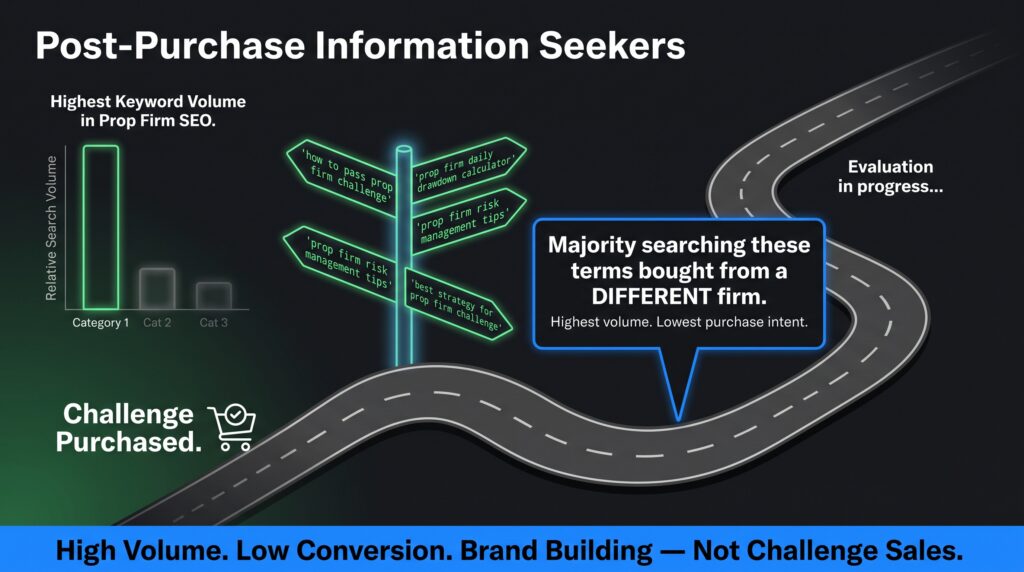
A prop firm challenge is a purchased product that requires ongoing work after purchase — the trader must manage drawdown limits, hit profit targets, and follow evaluation rules across days or weeks. The moment a trader purchases a challenge, they begin searching for information about how to succeed at it. These post-purchase searches generate the highest keyword volume in the prop firm SEO landscape.
The keywords in this category are immediately recognisable: “how to pass a prop firm challenge,” “prop firm trading rules explained,” “prop firm risk management tips,” “best trading strategy for prop firm challenge,” “prop firm daily drawdown calculator,” “prop firm challenge tips.” Every one of these keywords is dominated by traders who are currently inside a challenge — and in the majority of cases, that challenge was purchased from a different firm.
Category 1 — Example Keywords (High Volume, Low Direct Conversion)
“how to pass a prop firm challenge” · “prop firm trading rules explained” · “prop firm risk management tips” · “prop firm daily drawdown limit” · “best trading strategy for prop firm” · “prop firm challenge tips” · “how many prop firm traders get funded” · “prop firm profit target guide”
A prop firm that ranks at position one for “how to pass a prop firm challenge” is primarily capturing search traffic from traders who are currently inside a competitor’s active challenge and need help completing it, or traders who previously failed a challenge from another firm and are preparing to try again. In neither case is the searcher in an active purchase evaluation window for a new challenge today.
This does not mean Category 1 content has no value. Ranking for these keywords builds brand familiarity with the active trader community — the trader who found useful challenge advice from your content is more likely to consider your firm when their current challenge expires or they decide to buy an additional account. Category 1 content is a brand-building and community investment; it is not a direct challenge purchase driver.
The strategic mistake is allocating the majority of content production resources to Category 1 keywords because the volume numbers are largest, while Categories 2 and 3 remain underserved. The practical fix for existing Category 1 rankings: retain the content and add CTAs at the bottom linking to evaluation-intent landing pages — a comparison guide, a feature-specific challenge page, a challenge tier overview. Category 1 content can funnel toward Category 2 assets where conversion is possible, even when it does not convert directly.
Category 2: Evaluation-Intent Keywords
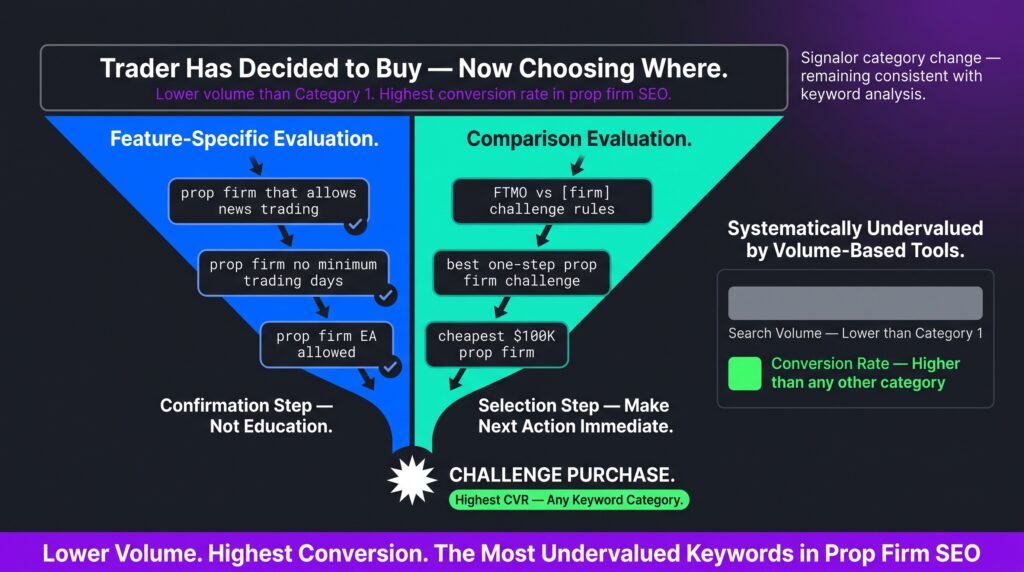
Evaluation-intent keywords are searched by traders who have decided to buy a challenge and are in the process of choosing which firm and which challenge format meets their requirements. These keywords have lower search volumes than Category 1 — sometimes significantly lower — which makes them systematically undervalued by volume-based keyword tools. They are the highest-converting keyword category in prop firm SEO.
Two sub-types exist within evaluation-intent:
Feature-specific evaluation. The trader has a specific trading requirement and is checking whether a firm meets it before purchasing. These queries convert at very high rates because the search is a confirmation step: if the content clearly confirms the feature match, purchase typically follows directly. The content does not need to educate — it needs to confirm specifically and make the next step immediate.
Category 2A — Feature-Specific Evaluation Examples
“prop firm no consistency rule” · “instant funding prop firm” · “prop firm no daily drawdown limit” · “prop firm that allows news trading” · “prop firm with highest payout percentage” · “prop firm two-step challenge no time limit” · “best prop firm for swing traders” · “prop firm no weekend holding restriction”
Comparison evaluation. The trader has narrowed their options to two or three specific firms and is making a final selection. Comparison queries (“FTMO vs Funded Next,” “best alternative to FTMO”) indicate the trader is at the last step of their evaluation. The content’s role is to be the tiebreaker — not to introduce the category. Conversion rates for comparison queries are high because the purchase decision is substantially made; the comparison is the final trigger.
Category 2B — Comparison Evaluation Examples
“FTMO vs Funded Next” · “The Funding Pips vs True Forex Funds” · “best alternative to FTMO” · “prop firm comparison 2026” · “which prop firm is best for scalping” · “cheapest prop firm challenge” · “prop firm with fastest payout”
Per the prop firm SEO timeline, evaluation-intent keywords are typically the first to reach top-20 positions — at days 90–120 — precisely because competition is thinnest for feature-specific and comparison queries. They’re also where the first organic challenge purchases arrive, which is why the Traction Phase produces its earliest commercial signal from this category rather than from the higher-volume Category 1 keywords the programme also targets.
What good Category 2 content looks like: a feature-specific landing page structured around one requirement, confirming it clearly and specifically (“yes, we have no consistency rule — here is exactly what that means for your evaluation period”), answering the natural follow-on questions without requiring a click elsewhere, and making the purchase step the logical next action. Not a long editorial piece. A clear, structured confirmation page that removes friction between the searcher’s requirement check and the purchase decision.
Category 3: Trust-Verification Keywords
Trust-verification keywords are searched by traders who are interested in a specific firm but not yet committed — typically because the prop firm industry’s history of exits, delayed payouts, and rule changes in 2024–2025 has made experienced traders cautious before making a financial commitment on a challenge. The query types are “[firm name] legit 2026,” “[firm name] payout proof,” “[firm name] withdrawal speed,” “[firm name] real or fake.”
This sounds like a sceptical audience unlikely to convert. It is the opposite.
A trader who Googled “[firm name] scam” and found documented payout history, specific withdrawal timelines, and transparent communication about risk has actively overcome their objection through their own research. This objection-overcome buyer converts with higher conviction than a trader who found the firm through a passive channel — a “best prop firms 2026” list or a paid ad — because the sceptical searcher arrived at their purchase decision through evidence, not just exposure. The last barrier was removed by genuine information rather than persuasion.
Category 3 — Trust-Verification Examples
“[firm name] legit” · “[firm name] scam or not” · “[firm name] payout proof” · “[firm name] withdrawal speed” · “[firm name] regulated” · “[firm name] 2026 review” · “[firm name] real or fake” · “is [firm name] trustworthy” · “[firm name] trader reviews” · “[firm name] payout time”
The failure mode for Category 3 keywords is when the firm’s own content does not satisfactorily answer the trust question. A trust-verification page with marketing language (“we have processed thousands of payouts!”) but no specific documentation converts at very low rates — not because the searcher is inherently non-converting, but because the evidence base does not remove the objection. Trust-verification keywords are a lever that works in both directions: genuine evidence drives high-conviction purchases; thin or evasive content drives the searcher toward forum threads and competitor comparisons.
What Category 3 content requires is genuine, timestamped evidence — documented withdrawals with dates and amounts, specific payout timing data (“requests processed within three business days, average two days in practice”), regulatory status stated with specific licence numbers, and independent trader testimonials with verifiable social links. Proactive risk disclosure — the challenge fail rate, the percentage of funded traders who withdraw successfully — is a trust signal, not a liability. Traders in a high-scepticism market read transparent risk disclosure as evidence of honesty. It is the opposite of what marketing instinct suggests and the correct call for a regulated-context financial product.
The Four-Step Keyword Conversion Audit
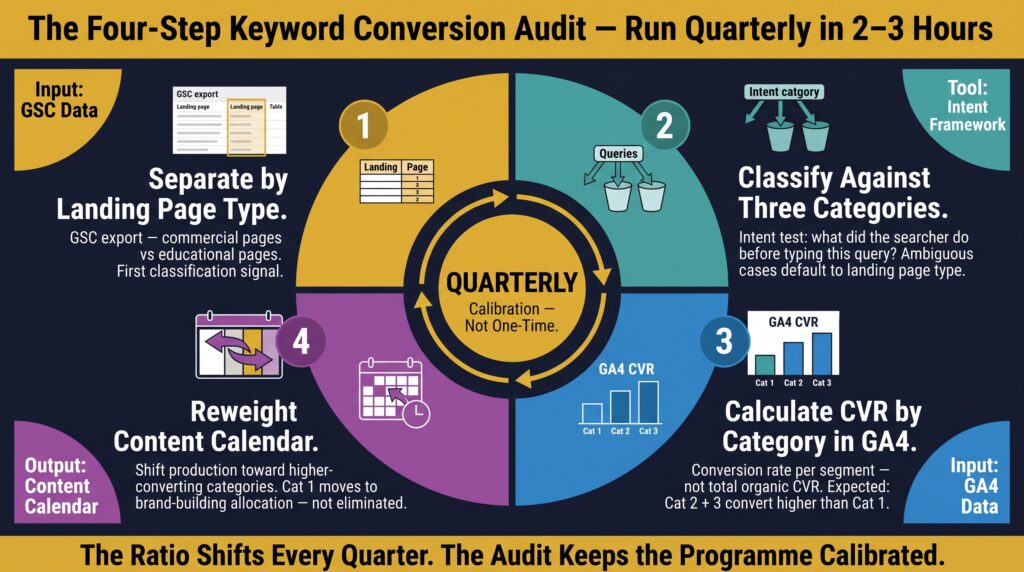
The three-category framework is only useful if you can apply it to what the programme already ranks for. The following four-step audit is designed to run quarterly in approximately two to three hours using GSC and GA4 data already available.
Step 1 — Separate keywords by landing page type in Google Search Console. Export all keywords driving clicks to challenge purchase pages, challenge tier landing pages, and comparison pages separately from keywords driving clicks to blog posts and educational content. Keywords reaching commercial pages are more likely Category 2 or 3; keywords reaching educational pages are more likely Category 1. This split is the first classification signal.
Step 2 — Classify each keyword against the three-category framework. Apply the intent test to each: “What has the searcher most likely already done before typing this query?” Already bought from a competitor — Category 1. Comparing specific options or checking a specific requirement — Category 2. Heard about this firm and conducting pre-purchase due diligence — Category 3. Ambiguous cases default to the category closest to the landing page type established in Step 1.
Step 3 — Calculate challenge purchase CVR by keyword category in GA4. Use the landing page split from Step 1 as a proxy for keyword category and calculate the organic challenge purchase conversion rate for each segment separately, not as a total organic CVR. The expected finding: Category 2 and 3 pages will convert at higher rates than Category 1 pages at equivalent traffic volumes. This confirms the framework against the firm’s own data and quantifies the conversion gap.
Step 4 — Reweight the content calendar for the next quarter. If Category 2 and 3 keywords are underrepresented relative to their measured conversion rates, shift content production toward evaluation-intent and trust-verification assets. Category 1 content does not stop — it moves from primary production priority to brand-building allocation. The audit is a quarterly calibration, not a one-time redirect. The ratio will shift as the keyword landscape and competitive environment evolve.
The keyword conversion audit starts from the diagnostic baseline. The prop firm SEO audit identifies current keyword coverage gaps across all three categories and maps the trust-deficit checkpoint against the evidence base required for Category 3 content to convert. For the AI visibility layer: the AI visibility audit covers whether Perplexity and ChatGPT are surfacing the right firm for evaluation-intent and trust-verification queries — a parallel channel with its own intent classification logic and significantly faster feedback cycles than organic search.
More in the prop firm SEO series: what a prop firm SEO audit checks, how long prop firm SEO takes, prop firm technical SEO, prop firm content strategy, internal linking for prop firms, why prop firms get outranked by review sites.
FAQ
Q1: What prop firm SEO keywords actually convert to challenge purchases?
Two prop firm keyword categories convert to challenge purchases at high rates: evaluation-intent keywords and trust-verification keywords. Evaluation-intent keywords are searched by traders in active comparison mode — feature-specific queries like “prop firm no consistency rule” and comparison queries like “[Firm A] vs [Firm B].” Trust-verification keywords like “[firm] legit 2026” and “[firm] payout proof” convert at high rates when the firm’s content provides genuine, evidenced answers. High-volume informational keywords such as “how to pass a prop firm challenge” typically convert at low rates because most searchers have already purchased a challenge from a competitor.
Q2: Why do high-volume prop firm SEO keywords often not drive challenge purchases?
The most common reason is that high-volume prop firm keywords are post-purchase information keywords — they attract traders who are already inside an active challenge bought from a competitor. “How to pass a prop firm challenge,” “prop firm trading rules,” and “prop firm risk management tips” generate significant search volume from traders who need help completing a challenge they have already purchased. These searchers are not in a purchase evaluation window. Ranking for them builds brand familiarity but does not drive direct challenge purchase conversions because the commercial decision has already been made with a competitor.
Q3: What are evaluation-intent keywords in prop firm SEO?
Evaluation-intent keywords are searched by traders who are actively comparing challenge options and have not yet made a purchase decision. They fall into two types: feature-specific queries, where the trader is checking whether a firm meets a specific requirement (“instant funding prop firm,” “prop firm no daily drawdown limit”), and comparison queries, where the trader is choosing between two or three specific firms (“FTMO vs Funded Next,” “best alternative to FTMO”). Both types convert at higher rates than informational keywords because the searcher is in an active purchase window rather than a post-purchase information-seeking state.
Q4: Why do trust-verification keywords convert when satisfied?
A trader searching “[firm] legit 2026” or “[firm] payout proof” is doing pre-purchase due diligence — they are interested in the firm but cautious due to the prop firm industry’s history of exits and delayed payouts. When this search returns genuine, evidenced content — documented withdrawals, specific payout timelines, transparent risk disclosure — the trader has actively overcome their objection through evidence. This objection-overcome buyer converts with higher conviction than a trader who found the firm through passive discovery, because the final barrier to purchase has been removed through their own research.
Q5: How do I identify which of my prop firm keywords are actually converting?
Run a four-step keyword conversion audit: first, in Google Search Console, separate keywords driving traffic to commercial pages (challenge purchase pages, tier landing pages) from keywords driving traffic to educational pages. Second, classify each keyword by intent — post-purchase information, evaluation-intent, or trust-verification. Third, in GA4, calculate the challenge purchase conversion rate for each keyword category separately rather than as a total organic CVR. Fourth, reweight your content calendar toward the categories that convert at the highest rates and are currently underrepresented in your keyword coverage.
Q6: What is the difference between evaluation-intent and informational keywords in prop firm SEO?
The difference is the searcher’s funnel position. Informational prop firm keywords are searched by traders who are learning about challenge trading or improving at a challenge they have already bought — they are pre-purchase or post-purchase with respect to the prop firm model but not in active purchase evaluation. Evaluation-intent keywords are searched by traders who have decided to buy a challenge and are comparing specific options — they are in active purchase evaluation. The commercial distinction matters because content optimised for informational intent satisfies a different need than content optimised for evaluation-intent, even when the topic appears similar.